The Mass Timber Movement: Building Smarter, Faster, and Greener for a New Era
At UC Merced, the Promise Housing project redefines what affordable student living can be.
The Mass Timber Movement: Building Smarter, Faster, and Greener for a New Era
guest post by By Scott MacLellan, President, Wood Inc.
Across the AEC industry, mass timber is moving from an emerging trend to a mainstream solution — not because it is novel, but because it is necessary. Cost pressures, labor constraints, carbon reduction goals, and rising expectations from communities and institutions are reshaping how buildings are designed and delivered. Mass timber offers a clear path forward when it is paired with discipline, coordination, and the right delivery model.
A Case in Point: UC Merced Promise Housing
At UC Merced, the Promise Housing project redefines what affordable student living can be. Developed in partnership with UC Merced, the project delivers 478 affordable beds within a 130,000-square-foot facility, along with communal lounges, study spaces, and a dedicated resource center to support students transitioning into university life.
What makes Promise Housing distinctive is not only its social impact — but how it was delivered.
From the outset, Wood Inc. worked alongside Build Group and BAR Architects to establish a true design-build structure, aligning design intent, cost discipline, and constructability from day one. That early collaboration created the platform for success, allowing mass timber to function as a core strategy rather than a late-stage material substitution.
This integration ensured architectural ambition, structural efficiency, and construction sequencing moved forward as one coordinated system.
Why Mass Timber Worked — Because It Was Designed to Work
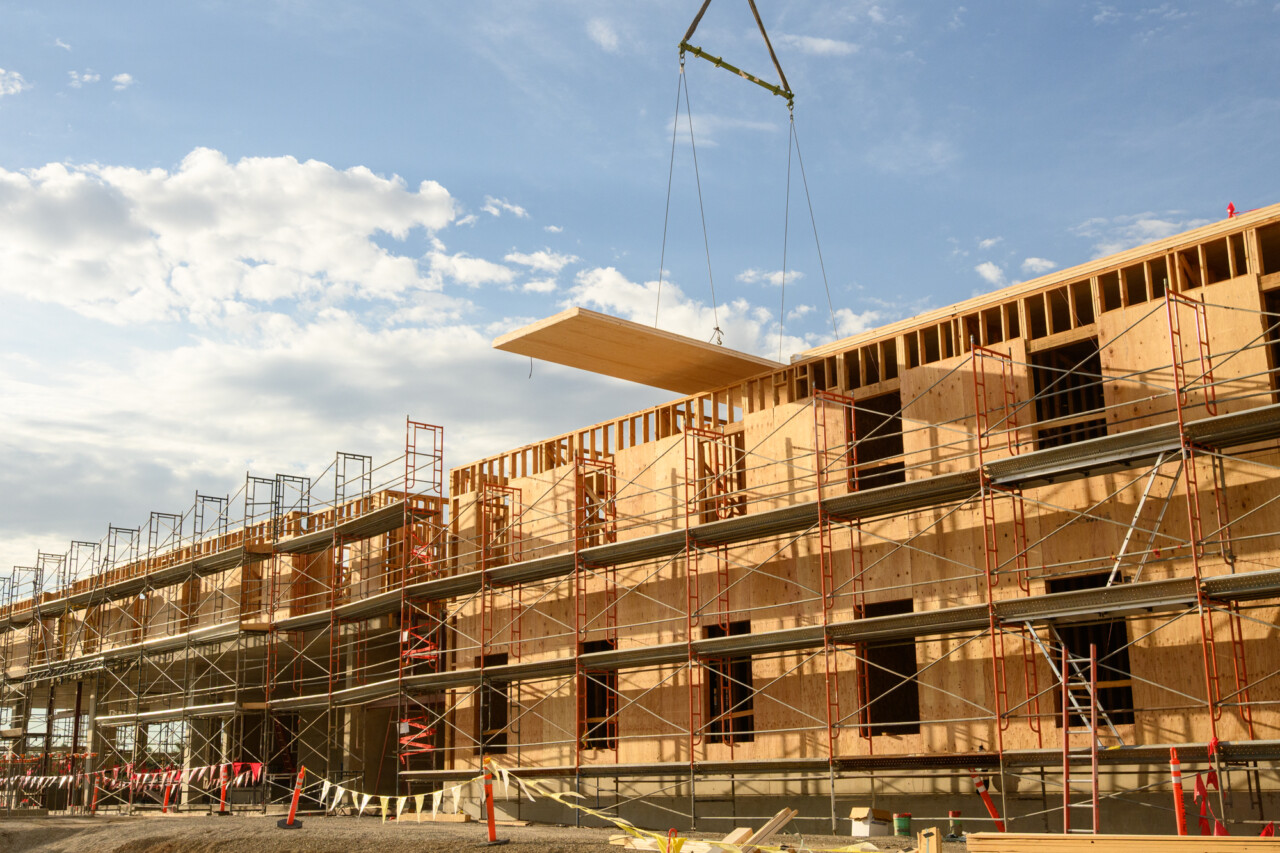
When mass timber panels are integrated into the structural system early, installation accelerates with smaller crews and fewer site hours. Their lighter weight reduces the load on foundations — an essential advantage in regions with challenging soil conditions, such as Central California.
Through the design-build framework led by Build Group and informed by Wood Inc.’s mass timber expertise, structural spans, panelization strategies, and sequencing were resolved early. The result was reduced rework, improved predictability, and faster schedules.
The outcome: shorter timelines, lower embodied carbon, and interior environments that feel warm, natural, and human—qualities difficult to replicate with conventional steel and concrete systems.
At Wood Inc., our position is simple: affordable multifamily housing does not need another white paper — it needs a buildable playbook. Mass timber is the playbook when it is paired with disciplined delivery.
Why Now: The Right Material, Enabled by the Right Model
Several forces are accelerating adoption:
- Schedule and labor efficiency: Panelized timber installs faster with smaller, safer crews — critical in high-cost, labor-constrained regions.
- Cost optimization: Reduced structural weight lowers foundation and seismic demands, while optimized spans reduce material across façades, partitions, and MEP systems.
- Revitalized Interiors: Gone are the typical ‘white boxes’ we have become so accustomed to.
- Carbon and wellness benefits: Timber sequesters carbon and enables exposed structural interiors that enhance biophilia and occupant well-being—often eliminating the need for additional finishes like drywall.
Data from the New England Forestry Foundation and WoodWorks confirms measurable gains in cost and schedule when mass timber systems are optimized by span, code classification, and building typology.
Mass timber is not just sustainable — it is strategic. But strategy only works when execution is aligned early.
Where It Wins — and Where Discipline Matters
Mass timber performs best when designed to its strengths:
- Ideal for four- to eight-story structures with stacking layouts
- Highly effective on poor soils or constrained sites
- Interiors design around maximizing exposure to wood elements
- Well suited for mission-driven projects prioritizing wellness, carbon reduction, and speed to occupancy
However, success requires discipline. Late-stage substitutions or design changes, unresolved fire strategies, or fragmented delivery models can quickly erode advantages. Mass timber must be the basis of design — and design-build with a knowledgeable team must be the basis of delivery.
A New Chapter for Civic and Campus Construction
From universities to housing to recreation centers, owners are rediscovering the value of building beautifully and responsibly. Mass timber combines the familiarity of wood with the precision of modern prefabrication—but it reaches its full potential only when paired with integrated delivery.
At Wood Inc., working alongside Build Group, we are not chasing novelty. We are creating buildable innovation—where design, cost, and execution reinforce one another.
Projects like UC Merced Promise Housing prove that mass timber is not just the future of construction.
It is the present — when delivered with the right structure, the right partners, and the right intent.